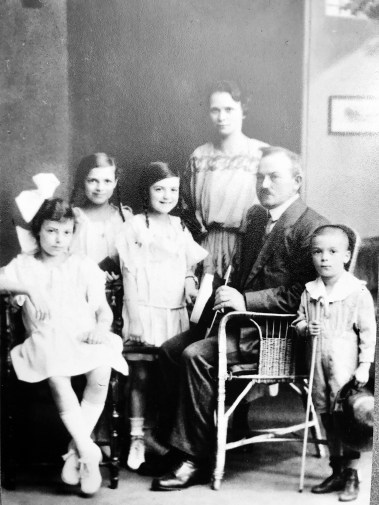
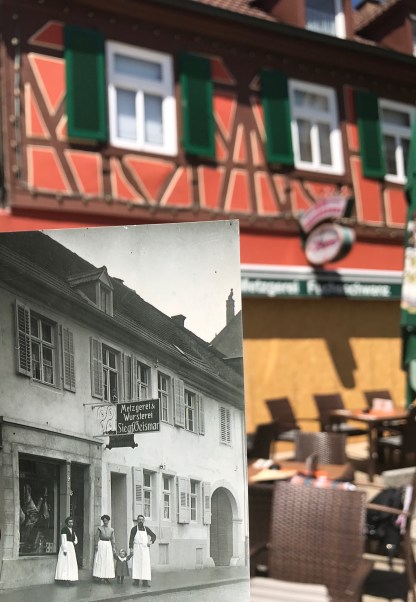
The German “roots” part of our trip began in the town of Offenburg, where my great-grandparents Siegfried and Judith Geismar lived, and for nearly 30 years owned a butcher shop, (Metzgerai & Wursterei Sieg. Geismar), in the lovely main square of town; they lived on the top floors of the butcher shop on Kreuzkirchstrasse 4. My grandmother Alice and her siblings Bella, Hedy and Norbert were all born in Offenburg and grew up in that lovely house in the center of town. My grandparents Alice Geismar and Paul Reutlinger were also later married in the synagogue in Offenburg.
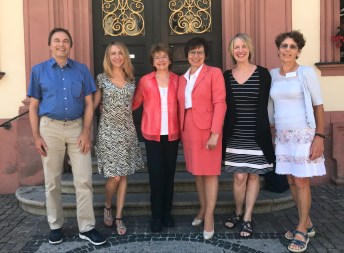
Our first stop in Offenburg was to the town Archive where we were welcomed by Dr. Wolfgang Gall, Dr. Martin Ruch, Anne Junk and Regina Brischle. Dr. Ruch is one of Offenburg’s historians and has written many books on the Jewish communities from the state of Baden-Württemburg and Offenburg in particular, and has a deep understanding and knowledge of what happened to the local Jewish people before, during and after the war.
Dr. Ruch had taken over for Hans Fliedner who had dedicated much of his career to making sure that the Jewish community of Offenburg would be remembered and that each person who survived the war should be welcomed back. For many years Herr Fliedner reached out to my grandmother Alice in hopes that she would agree to return for a warm welcome by her hometown community, but my grandmother would have nothing to do with Offenburg, or Germany. He wrote her many letters, sent her articles, and kept her updated of commemorative events and happenings in Offenburg. My mother told me that the letters, news and invitations from Herr Fliedner kept arriving even after her death in 1984. She was adamant. She never again would step foot in Germany. My grandparents, aunts and my uncle were not only humiliated and devastated by what had happened to them, their families, and the Jewish community, but they also felt betrayed by many friends and neighbors who at the time turned their backs on them.
We were impressed by the continued dedication of the people we met at the Culture Department at the Offenburg Archive. They have worked hard to preserve the history of this lost Jewish community who were at one time fully integrated into German society.
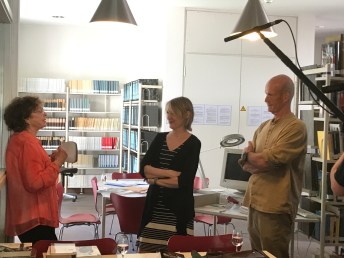
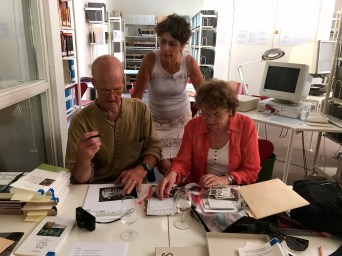
We interviewed and filmed Dr. Ruch who guided us through a great deal of information concerning our family.
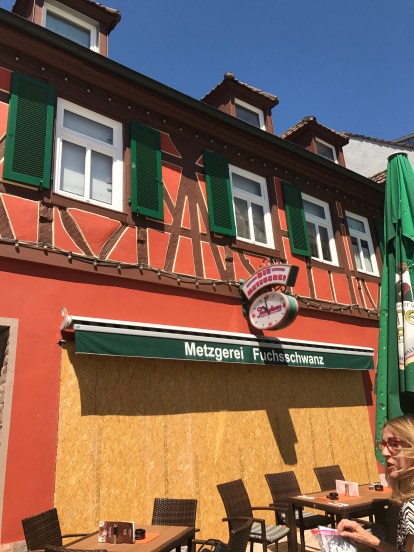
Renee Hauser, who came to interpret for us, is a Michigan native who now lives in Germany. She with Dr. Wolfgang Gall, and Anna Junk took us to see our great grandparents’ former butcher shop which at the time of our visit was still owned by the Fuchsschwantz family, and until a few months ago was still an actively running shop. In the front of the shop was a stolpersteine or “stepping stone” in remembrance of my great-grandfather Siegfried Geismar who was killed in the extermination camp Majdanek in Poland in 1943. We were disappointed to see that the café next-door, which had taken over the sidewalk area in front of the shop and house had one of its outdoor tables and summer umbrellas covering up half of the stone. We lifted up the umbrella’s cement block, cleaned off the stone and hoped that if any of our family comes to visit in the future, it will be totally uncovered. The stone said: Here lived Siegfried Geismar. Born 1879, Deported 1940 to Gurs and killed at (concentration camp) Majdanek.
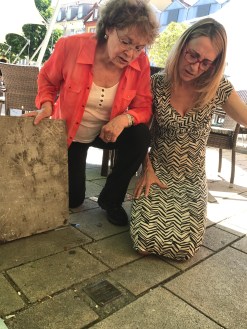
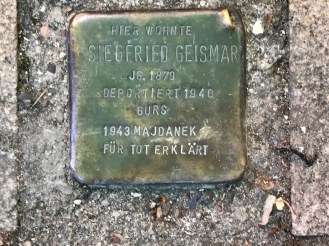
Link to Offenburg’s Stolpersteins, including a page on Sigfried & Judith Geismar: stolperstein_brochure
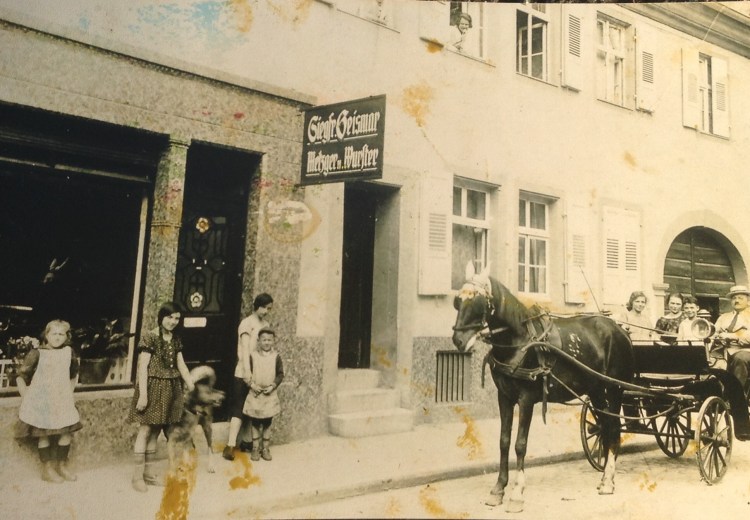

On April 1, 1933, only three months after Hitler came to power, he ordered an economic boycott of all Jewish businesses. SA officers (Sturmabteilung – Storm Troopers or Brownshirts) were placed outside of all Jewish shops and businesses around Germany. This marked the beginning of the nationwide campaign by the Nazis against the Jews.
The Nuremberg Laws went into effect on November 15, 1935, depriving Jews of their rights and citizenship, and among many other restrictions, prohibited non-Jews from shopping at Jewish owned businesses. A sign was put into the Geismar’s shop window, “Do Not Buy From Jews”. It was impossible for them to keep their shop afloat and pay their bills.
At seven in the morning on November 10, 1938, on what is known as Kristallnacht, SA officers stormed the Offenburg synagogue smashing the lights, benches, wall hangings and destroyed the Torah scrolls. Later that afternoon, a mob of 70 destroyed the rest of the synagogue, along with most Jewish businesses in Offenburg. The synagogue was later to be demolished completely, but for various reasons the town was unable to do it. All of the men in the Offenburg (and across Germany) were taken to the Dachau concentration camp to be put in “protective custody”. For those who left, their assets were confiscated by the Reich and their businesses were “aryanised” – sold to Christian neighbors under value.
Siegfried and Judith were forced to close their business. Their home, shop and most of their belongings were sold at a state auction (for pretty much nothing), and they were forced to move to another small apartment house along with three other Jewish families (we think one of the families were relatives). Siegfried, Judith and my great aunt Hedy, who was then twenty-six, had to squeeze into what was referred to as “Jewish housing” at 17 Gaswerkstraase. At this time Alice, my grandmother, was already living in Lörrach (since 1926), Bella had left for Israel (1935), and Norbert had been sent to the U.S. (December 1936).
The descendants of the Fuchsschwanz family, who had taken over the shop in 1939, still owned the shop when we visited in 2017 (although it had closed down to be sold).
We visited the apartment house at 17 Gaswerkstrasse, it was a boarded up mess and situated behind a beautiful apartment house of the same address.
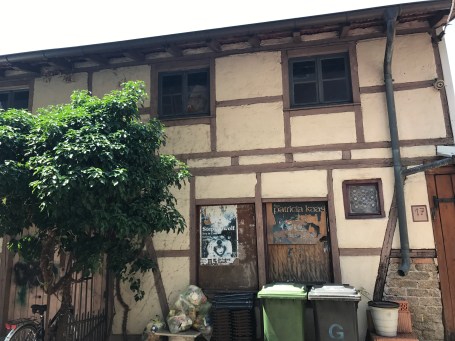
On the fateful morning of October 22, 1940, all of the Jews remaining in Baden (southwest Germany), mostly the elderly, were deported to the Gurs internment camp in Vichey France in the south near the Pyrenees. Two Nazi or S.S. officers were stationed outside every Jewish home and they ordered each person to pack up only one one bag, to take no more than $100RM (Reichsmark – the currency at the time), and were marched to the gymnasium of the upper school. They were forced to sign over their belongings to ?.
They were then taken from the school along with the ninety one Jewish community members in Offenburg, and were brought by trucks to the train station for deportation where the rest of the Jews in the area were also gathered. It was mostly the older population that were there, as many of the younger generation had already emigrated. The trains left at 11 o’clock at night traveling to the west, which was a relief that it wasn’t in the direction of Poland. They traveled for 4 days until they finally reached the Gurs internment camp. That was the last time they would step foot in Germany.
Also deported that same day from Lörrach were four of Judith’s siblings – Ludwig, Samuel, Isaak and Adele Beck, her sister-in-law Elise and Elise’s sister Emilie Heilbronner and her nephew Walter Beck. Her daughter Alice (my grandmother), Paul (my grandfather), and my mother Ronia were deported to Gurs from Freiburg.
By the end of 1940, Judith’s brothers Ludwig and Samuel and her nephew Walter had all perished in Gurs. After being sent from Gurs to Recebedou, a camp for older people in southern France, Adele, Isaak, Elise and Emilie were sent to Auschwitz via Drancy and murdered in August 1942.
Siegfried and Judith both survived Gurs and were eventually transferred to Noe and Recebedou.
Towards the end of the war, Judith was sent to Macón in Burgundy, France where she remained with nuns until she was ultimately reunited with her sister Babette and her sister’s family, the Hammels in Strasbourg, France. Life was hard for her, especially in her weak state. She didn’t know what had happened to her husband, daughter, granddaughter or siblings. We have many handwritten letters from Gurs which still need to be translated from German to English in order to be able to trace and better understand her story. We’re still trying to discover exactly how she managed to survive.
Siegfried was was ultimately transferred in 1943 from Recebedou (via?) to Majdanek Poland in where he was killed.
____________________________________________________________________________________________
Back to our trip…
After lunch we had an appointment to meet with the mayor of Offenburg, Edith Schreiner, who was very welcoming. She gave us an official welcome reception to Offenburg at her office, and presented us with a beautiful coffee table book on Offenburg. At her office, my mom told her the story of her parents and grandparents.
We toured the old mikvah (a Jewish ritual bath) from the 1300s which was next to the former synagogue. It was built of brick with a winding staircase that led way down into the very depth of the earth. It was a very hot day when we visited, but the bottom of that stone mikvah was freezing cold. At the top of the stairs there was a memorial for the Offenburg Jews who had been deported. A garden of stones was set up by local school children. It reminded me of the stones left on top of grave stones at Jewish grave sites. Each stone had the handwritten name of a person who was had been deported and killed. We easily found my great-grandfather Siegfried’s stone. The Offenburg Archives also has a profile of each Jewish community member, researched and written by a local student.


Dr. Gall took us to the former synagogue (the Salmen) where my grandparents had been married in 1935. It looked nothing like what it did back in the time when they lived there. In November 1938, during the Kristallnacht pogrom (The Night of Broken Glass), the synagogue could not be bombed or totally destroyed because it was built into the walls of the city but the interior was totally desecrated. In 1997 the city of Offenburg restored the building. This was a very important goal and project for Herr Fliedner and he retired two weeks after the reopening of the building. We were sorry that we were not able to meet him. The former synagogue now serves as a memorial center for German history. One of the exhibits commemorates the annihilated Jewish community of Offenburg. In a darkly lit room, are haunting photographs of the former Jewish community. My great-grandparents Siegfried and Judith, as well as my great aunt Hedy (who turned 105 in June 2017) were displayed there.


As we made our way through Offenburg and the surrounding area, the food began to become familiar to me. I remembered the school lunches that my mother had packed for me when we first arrived in NY in 1946, liverwurst and rauchfleisch (smoked meats), just like in the old country. The Alamanish dialect I heard in southern Germany also sounded very familiar to me, unlike Hoch-Deutch (high German) spoken in much of the rest of country .–rb
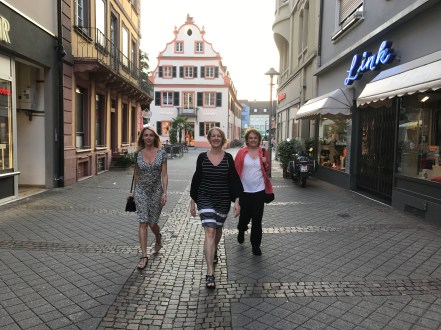
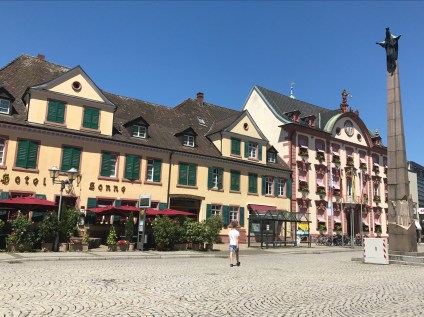
On our last night in Offenburg, despite the hot weather, we ate outdoors, at the beautiful Hotel Sonne in the center of town. Although the trip was exhausting, mom held up well (it must be all that exercising at the gym!). We were up early in the mornings, with little sleep, no free time during the day because we were constantly filming, skipped many dinners (and sometimes lunch), and never went to sleep until past midnight.
The Geismar Piano (A touching story)
Following our visit to Offenburg, Dr. Gall received a call at the Archive from a local community member who had read an article about our family’s visit to Offenburg and desperately wanted to talk to us. The gentleman wanted to let us know that his brother-in-law was sent by his parents as a little boy to my grandparent’s butcher shop when it was forbidden for non-Jews to buy from Jewish merchants. Shortly before the 1940 deportation of all Jews from Offenburg, my great-grandparents, when they had to sell all their possessions on auction, gave the boy’s family their piano. The piano is still with him and his wife and their children all learned to play on this piano. He wanted to tell us the story and invite us to see the piano. Unfortunately, by the time we got in touch with him we were already in Geneva,Switzerland, which was too far to come back to meet him–we were all disappointed. We are hoping that we can get his story and a picture of the piano soon, and one day go to visit.
Article mentioned above from our visit in the newspaper Badiche-Zeitung: http://www.badische-zeitung.de/die-arisierung-als-grosser-bruch-im-leben-der-familie
 rootstravel.blog
I am visiting Offenburg in March for similar reasons and would love to contact some of the historians you referenced. Please reach out to me if you can.
LikeLike
Hello Stefan! I am happy to connect. I will email you directly.
LikeLike