In December 1936, my mother Ronia was born in the border town of Lörrach in the southwest part of Germany (Baden/The Black Forest) directly across the border from the Swiss town of Basel.
My great-grandmother Judith Beck Geismar, her parents Daniel Beck and Auguste Werthheimer Beck, and her siblings Isaak, Emma Beck Heilbronner and Adele and half siblings Babette Beck Reiser, Ludwig, Samuel, Bernhard and Gustav were also born in Lörrach. Judith had four children with her husband Sigfried Geismar. Alice, my grandmother was the eldest of the four (Bella, Hedwig (Hedy) and Norbert). Although my grandmother Alice was born in Offenburg, a town about an hour north of Lörrach, she lived with her aunt Emma and her cousins Else and Alice in Lörrach in order to attend school a boarding school in France with Else. Alice very much wanted to become a teacher, but her father would not agree to that — he thought she should have a trade (perhaps an insight into what was to come?). She subsequently went to school with her cousin Alice to become a dressmaker. She eventually worked in the Swiss town of Basel supervising dressmakers. My grandmother was a perfectionist, every item she made, in fact, everything she did had to be done perfectly ( a quality that was very useful in her later years.)
In 1935, my grandfather Adolf Paul Reutlinger (later known as Paul), who was trained as a Cantor and religious and public school teacher in the north of Baden (Wurtzburg), was transferred from a synagogue in Lichtenau to work as the Cantor in the Lörrach synagogue.
My grandparents met in Lörrach in 1935. After a short courtship they were married that same year. My mother was born in Lörrach at the end of 1936.


In April 1933, in Lorrach and elsewhere in Germany, there was a boycott of all Jewish businesses. Nazis and SA stood in front of Jewish owned businesses and doctors offices and threatened the owners and customers.
In September 1935, the Nuremberg Laws went into effect which deprived all Jews of their rights. Jews could no longer marry “German” blood, signs were put up in local businesses stating “Jews unwelcome”, Jews had to register their property and Jewish businesses were “Aryianized” so that you could no longer employ Jewish workers. Most Jewish owned businesses were forced to sell their business to non-Jews at bargain prices since they no longer could sustain their businesses. Jewish doctors were forbidden to treat non-Jews and Jewish lawyers were forbidden to practice. German identity cards were now stamped with a red letter “J” and all Jews had to take the middle name “Sarah” for a woman and “Israel” for a man. Times were getting bad. From 1933 to 1939 the number of Jews in Lörrach went from 162 to 67 as the jewish community started to emigrate to other countries, if they could.
On November 9th/10th 1938 (Kristalnacht), when my mom was almost 2 years old, over 1,000 synagogues and 7,500 Jewish businesses in Germany were looted and destroyed, including the synagogue in Lörrach where my grandfather worked as a Cantor. The next day, the men in many German cities, including Lörrach, were arrested “for their protective custody” and transported by train to concentration camps. My grandfather, and great uncles Isaak, XYZ were sent along with the other jewish men for about 5 weeks to the Dachau concentration camp near Munich. They were humiliated and intimidated, forced to transfer their property and then set free after they were persuaded to leave the country. After that awful night, Jewish children were forbidden to attend German public schools.
Shortly after my grandfather’s return to Lörrach, Adolf was sent to work in Freiburg since there was no longer a synagogue in Lörrach and the Jewish community had dwindled. He packed up and took my mother and grandmother and for a job teaching at the Segregated Jewish School (The Lessing Mandatory School) in Freiburg where many Jewish children from the entire Baden area were sent after they no longer were allowed to attend public school.
_________________________________________________________________________________________
In advance of our visit to Lörrach, we had connected with the office of Culture and Tourism. Lars Frick, the head of the department and others from his office graciously helped us organize and plan our visit in advance of our arrival. He also connected us with Ulrich Tromm, a retired history teacher and local historian. Mr. Tromm was invaluable to us with regard to personal and contextual information on our family.
We first met Ulrich (except for our surprise and chance meeting in the archives in Freiburg) outside the cafe in front of the Stadt Hotel in Lörrach hotel. He was bursting with information for us and we, of course, were dying to talk with him. We were able to sit and talk for a bit (a rarity on this trip) since we had to wait a while for Judi to get back from our last shoot before we could leave for dinner. He took us for a walk down Teischstrasse – the same street where our hotel was located and many of our ancestors lived. He made a comment that the street really should be called Beckstrasse, because so many of our (Beck) family members had lived on this street.
For dinner, we took a taxi up a hill in town to a beautiful restaurant, Maien, which overlooked the city of Lörrach. Just 2 minutes further up the road is a park with views over the border of Switzerland, France and Germany. Ulrich had also invited a local Lörrach family to join us, the Kuhns. The grandfather Kuhn in the 1930s had been a patient of Dr. Moses, the grandfather of my neighbor in NYC (and later we found out that Dr. Moses was also our family doctor in Lörrach)! The family had lots of interesting stories for us on the Kuhn grandfather who was an archeologist and teacher and was contracted by the Nazis to prove German racial superiority. He used his position as an academic to gain free access to cross the border to the University of Basel “to conduct research” and would secretly smuggle news on the conditions in Germany to a Swiss journalist. He also helped a number of Jewish families escape to Switzerland.
The next morning, Marcus Moehring, the head of the Dreilander Museum in Lörrach, along with Lars and Ulrich, took us on a private tour of the museum. Herr Moehring was very knowledgeable about the exhibit which showcased various items that were collected in remembrance of the town’s Jewish past. The museum also houses a rare and interesting collection of photographs of the 1940 deportation of the Jewish community – and the museum is the only one in Baden to have such a collection.
The mayor of Lörrach, Jorg Lutz, invited us to for a rooftop reception on the terrace at his building to welcome us to Lörrach. It had a beautiful view over all of Lörrach and Switzerland. Mayor Lutz gave us a welcome speech and presented my mother with interesting books related to Lörrach, the Jews and the war, unfortunately they are all in German, so it will be a real effort to read them. They offered us drinks and sandwiches that looked like soft pretzels, which are typical from the area. News media from a few various papers also greeted us and were there to ask questions.
We had a wonderful lunch outdoors at a new hotel near the mayors office with Ulrich and our camera crew, Tim and Enrique. Ulrich was well informed on all things Lörrach during the war times – and has also conducted his own research on our family in preparation of our visit. We really enjoyed and appreciated the time we spent with him.
We walked down Teichstrasse where I once lived with my parents, my mother had lived as a teen, and my grandmother Judith and her family were brought up. We visited Teichstrasse 9, where my great uncle Benhart had a butcher shop, and where the only synagogue in town once stood. Ironically, the place where the Heilbronner’s once lived (we think) was turned into the hotel where we were staying!
We learned that my father was the last Cantor in Lörrach. Recently a new synagogue was opened for Eastern European Jews who have started to make Lörrach their home. – rb
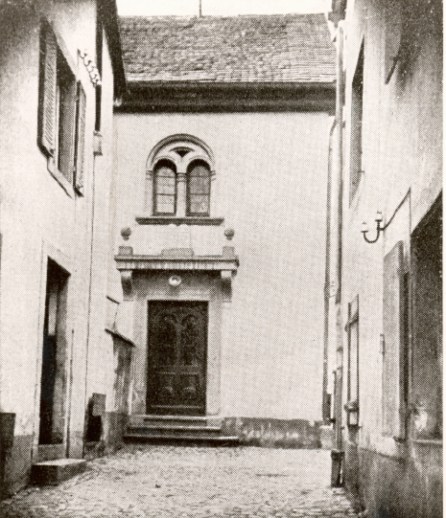
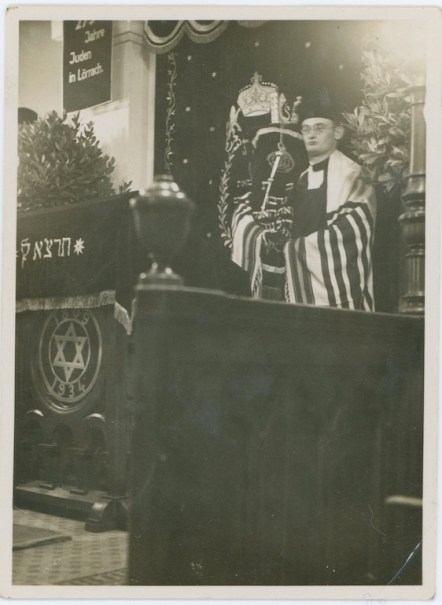
Adolf (Paul) Reutlinger, Cantor, Lörrach


Also on Teichstrasse, down the street from the synagogue and my family’s home, there is a memorial which was erected not too long ago, for the Jews of Lörrach deported to Gurs internment camp in southern France. Of the 50 Jews deported, six of those listed are from our family: Adele Beck, Issak Beck, Walter and Samuel Beck, Babette Beck Reiser and Emilie Heilbronner. (Bernhart Beck had died the previous February from pneumonia). There are two photographs on the memorial of the actual deportation which took place in the main square of Lörrach. These photographs are very rare as it was illegal to document the incident. One of the photos shows the German townspeople looking on as the Jews were taken away, it was haunting.
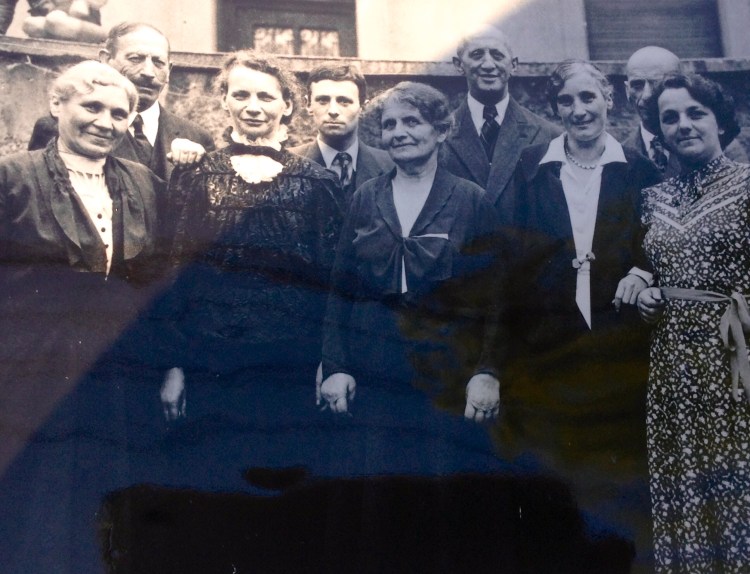
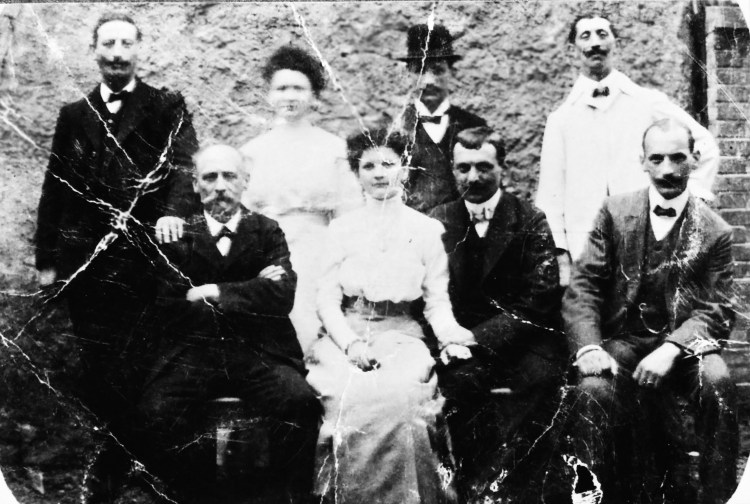
Seeing our family names inscribed on the plaque, we wondered what their lives were like before the war and what they went through during the war years. I left feeling so much more connected to my German roots and family. And with many more unanswered questions. Below is a photo of the Beck family in Lörrach. Unfortunately, only about half in the photo survived the war.

 rootstravel.blog
One thought on “Lörrach; Ronia’s birth town and hometown of great-grandmother Judith Beck and the Günzburger family.”