In our quest to trace my grandfather’s footsteps during WWII, I was lucky enough to come across Rosita Dienst-Demuth, a history teacher at the Lessing Realschule in Freiburg. Rosita had published a book in 2004 on the “The Forgotten Jewish School” (Lessing Realschule) and its important position during the war as a segregated Jewish school. My grandfather had been trained as a religious and public school teacher, as well as a Cantor. After the synagogue in Lörrach had been burnt down on November 9th, 1938 (Kristalnacht) he was sent to Freiburg to teach. I figured this must be his school.
I wrote to the school administration, but in the meantime kept searching for Rosita. I was very surprised to find a website that she had created about the history of the school and smack in the middle on the home page of the site was a picture of my grandfather and his students! What a shock to discover this. We finally connected and corresponded back and forth up until we arrived in Freiburg. We were so happy to have made contact!
The Lessing-Realschule, we learned, was one of a few mandatory Jewish schools in Baden that was set up after the Nazi regime no longer allowed Jewish children to attend regular public schools. For 15 years Rosita has worked with her students on the history of this school and they have reached out to its former students and teachers. They have found nearly 30 of the surviving Jewish students and had invited them back to the school in 2004 when they installed a memorial tablet about the school in remembrance of the day, October 22, 1940, when all Jewish residents of Freiburg, including the students and teachers, were deported to the internment camp Gurs in southwestern France. The memorial tablets listed all of the students’ and teachers’ names, including Adolf Reutlinger, my grandfather.
Link to the website on the history of the Lessing-Realschule in Freiburg where Paul A. Reutlinger worked.
Link to information (in German) about the Jewish Schoo in Freiburg: https://www.swr.de/swr2/stolpersteine/themen/juedische-zwangsschule-freiburg/-/id=12117604/did=14934186/format=pdf/gp2=12443060/nid=12117604/l04p30/index.html
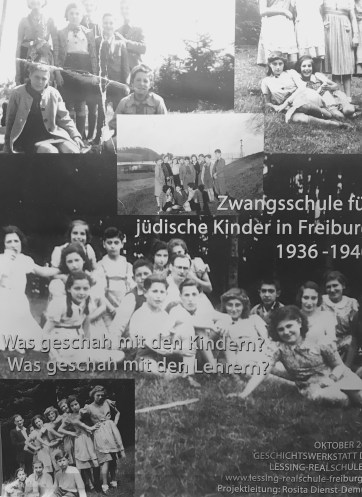
In 1936, when the Mandatory School first opened at the Lessing School, it was an all boys school. There was a separate entrance for the Jewish children in the back of the school as they they were not allowed to use the same entrance as the Aryans. In 1938 the Mandatory School was moved to a community center which no longer exists.
The Mandatory School for Jewish Children – English Translation
In this building, Jewish children from Freiburg and the region were taught. Due to racial laws, they were no longer allowed to attend regular schools. These students, their families and teachers suffered under the National Socialist policies of persecution and destruction. Thanks to the courageous people from the resistance, many of these children were able to survive. Their families and friends were not.
Those who saved these children are an example to all of us of tolerance and courage. We grieve with the survivors for those who were murdered.
From October 21st 1936 until the pogrom of November 10th 1938, the mandatory school was housed in this building. From March 1939 until the deportation of October 22nd, 1940 to Gurs in southwest France, schooling took place in the Jewish community house next to the destroyed synagogue on Werthmannplatz.
Rosita invited us to the school to meet her students and learn more about its history and asked my mom if she would talk about her experiences to a class of children. She presented to us an overview of the school and a few students also gave presentations. One student told us of a remembrance program, which is a tribute to the unsung heroes of the war. They honored heroes who were strong and courageous enough to risk their own lives and help during these extremely difficult times. An officer from Toulouse who helped many people, including families and scouts, escape by providing counterfeit papers. He also joined the resistance and refused to turn over the names of Jewish families when he was caught. Another was a police guard from Freiburg who helped a family escape and the third was a pupil from the school who joined the resistance. These heroes were honored with a memorial plaque placed outside the school and a tree planted in their name.
My mom, in her broken German, told her story to the history students – she did great! She was progressively getting more fluent as our visit to Germany got underway. Rosita helped her with German words she no longer remembered. At the end of the presentation, a few girls approached her – they were touched by the story. One girl was moved by the story of a French policeman who my grandparents had passed on the way to the Perpingion France train station while trying to escape the Rivesaltes internment camp. He almost brought them back to the camp but had a change of heart and helped them make it onto their train which got them to the next stage of their journey.
Before we left my mom gave each of the girls a big hug and told them that she hoped that they will be one of the good ones who in the future will also make a difference in someone’s life.
While in Freiburg, the Lessing Schule just happened to be holding a short lived exhibit at a local media museum about the Jewish Mandatory school during WWII. The exhibit contained photos of my grandfather as well as my mother and grandmother from the internment camp Rivesaltes!
Rosita had prepared an amazing homegrown lunch for us that she brought with her to school. The food was fresh from her garden, picked that morning, and spectacularly prepared.
After lunch she took us to see the apartment house where my family once lived on the former Adolf Hitler Strasse (now the main street Kaiser-Josef-Strasse). The ground floor of the building is now a Starbucks. My mother lived with her parents in this apartment house from the age of two until she was four years old when they were deported to Gurs on October 22, 1940.
Rosita connected us to three former students of the Lessing Realschule who remembered my grandfather – Kurt Maier, Eva Cohn and the Judas family! Kurt Meir lives in Washington D.C. and we hope to meet him soon, Eva lives in London and we met her following our trip, and the descendants of the Judas family live in New York City. We look forward to getting in touch with them all to connect and exchange stories.
We were impressed by the hard work and dedication that Rosita has put into preserving the memory of that horrible point in time during WWII.
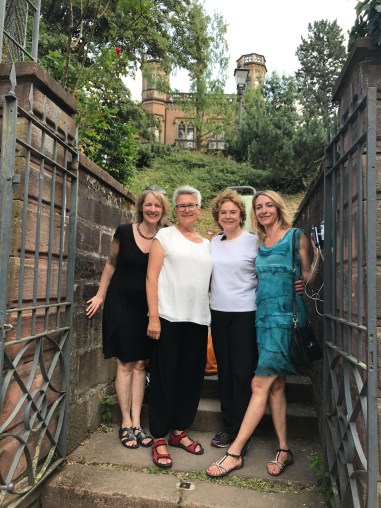
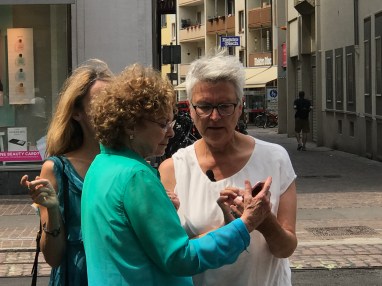
The city of Freiburg is beautiful. The grand cathedral was not destroyed during the war and was spectacular. Bächle (small water pathways that flow throughout the old city) are scattered throughout the city streets, originally formed from Glaciers and now come from the river.
_________________________________________________
Mom and I took a much need break for a few hours while Judi waited for new photographers to arrive and we walked around the city.
Deportation to Gurs – October 22, 1940
ON THE MORNING OF OCTOBER 22, 1940, teams of police pounded on the doors of every Jewish home in Baden and Pfalz/Saar, the southwestern German states bordering France. The S.S., Nazis, etc. came with lists of names secretly compiled shortly after France’s surrender. They had precise instructions on how to carry out the arrests, the expulsion and the deportation: who to arrest, how much time victims had to pack their things, what they could bring with them, how to treat the remaining property, even how to obtain receipts for the victims’ pets taken in by neighbors.
They were allowed an hour to pack, and each household was permitted to take 50 kilos of luggage and 100 Reichsmark in cash. All other possessions that had to be left behind were seized and inventoried, to be sold at auction for the benefit of the German government.
The deportation order was known as the Wagner-Burckel Aktion for the two Nazi administrators who engineered it. The day after the Jews were expelled from their homes, Wagner proudly claimed that his area was the first in Germany to be Judenrein, free of Jews, as Hitler had desired.
The arrested Jews were taken to collection points at railroad stations, packed into special trains for a two day and two night trip to the south of France, the internment camp Gurs.
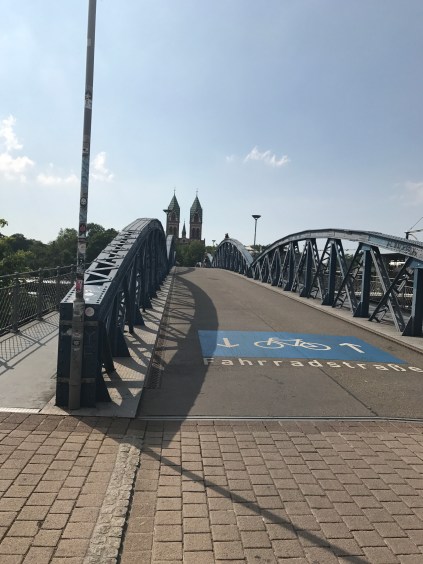
Rosita and her friend Katya brought us to the train station in Freiburg from where my mother and grandparents along with all of the other Jews of Baden were deported. We walked across the long bridge that had a memorial plaque marking the entrance alongside a jacket hanging over the side rail that had the word Juden inscribed on the front. The plaque read:
On 22.10.1940, more than 450 Jewish citizens from Freiburg and the surrounding area were deported, on command of the NAZI leadership, from the Great Hall of the station at that time, into the south French camp of Gurs. Many of them perished in Gurs through hunger and disease, most of whom were murdered in the Auschwitz extermination camp.
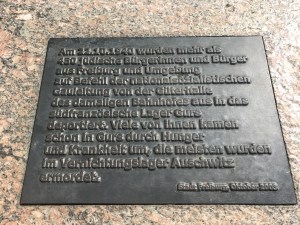
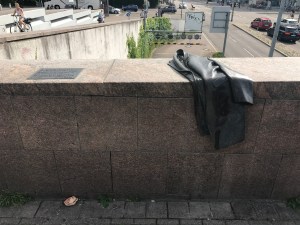
Walking across that bridge with my mom, 76 years after she had crossed the bridge for the last time holding the hands of her frightened parents, I imagined it was 1940 and they were walking with 400 other terrified and confused Jewish people, not knowing their destinies. Families, the elderly and students alike – including those who my grandfather taught – many of whom were alone, crossed that bridge into a school yard to wait for the trains of deportation. It was incredibly emotional.
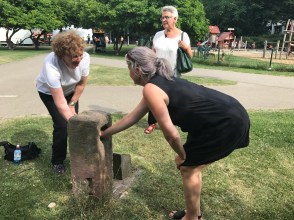
A separate memorial was installed by local school children where the Jews gathered and waited to be taken away.
Within the memorial was a hole for people to hold hands in unity and peace.
A SERENDIPITOUS MEETING with Mr. Tromm: In a very last minute decision we ran to the Freiburg State Archive before it closed because we heard that there were documents that only my mother could access, and this was the last day that we’d be in the area. We rushed in and looked for someone to help us. It was already 3:30 and the Archive closed at 4PM. While we were waiting, a gentleman who had heard all the commotion came out and said “I think I have an appointment with you on Sunday”. We were so confused – we hadn’t planned our trip to the Archive for that day, we wouldn’t still be in Freiburg on Sunday, plus – the Archive wss closed on Sundays.
He repeated – “Yes, we have an appointment on Sunday.” My mother asked “Who are you??” He told us his name, and our mouths dropped. He was Ulrich Tromm – a gentleman from Lörrach (where my mom was born and over an hour away) with whom I had been corresponding for many many weeks. He is a former history teacher and now a historian and he had taken a keen interest in our family story. He had been sending emails to me almost every day with a new “find” about our family. And he had been visiting city archives to collect information for us. Today, he just happened to be in Freiburg – at the same time we were there – doing research on my great-grandmother’s family! We were all in shock – including him! He kept saying “Mein Hertz, Mein Hertz” (my heart, my heart). He and Rosita had also heard about each other and were happy to meet in person and make the connection. Now we only had about 15 minutes before the archive closed and we rushed to review the documents, but of course they were in German. Luckily, since we all happened to be at the Archive at the same time, we were able to sign a release to allow Mr. Tromm to view and copy the documents for us. We were overwhelmed with the number of documents that they had on my grandparents and mother – from deportation papers to restitution papers. We thought that Mr. Tromm would be the best person to review the documents anyway because he would know what was important and what wasn’t. We parted ways only to meet again on Sunday, at dinner, in my mother’s town of birth, Lörrach.
 rootstravel.blog
One thought on “Living and Teaching in Freiburg 1938-1940. The 1940 Deportation of the Baden Jews.”