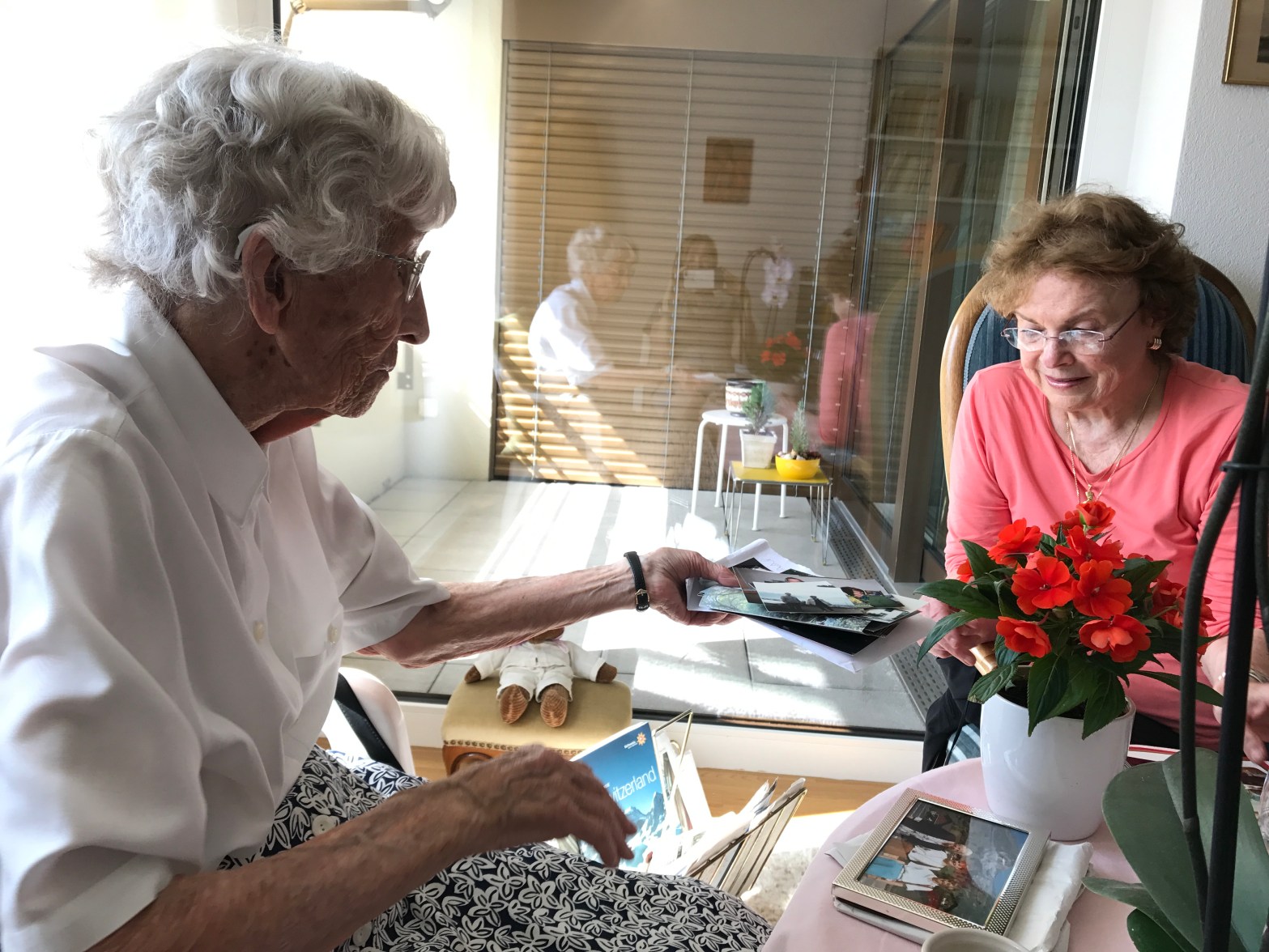
During our journey, connecting with dear friends and family who played important roles in our lives was our top priority. We began our trip in Zurich to visit Elsi Wehli. At almost 98 years old in 2017, Elsi worked in Switzerland helping the refugees like our family and became a cherished, lifelong family friend.


My mom and I arrived Zurich tired but excited in anticipation of our journey ahead.
While Judi was on her last day of acting in a movie in Paris, mom and I spent our first few days in Zurich with Elsi. During WWII, when Elsi was 24, she worked for Louise Neff who, like my grandparents, was about 33 years old at the time and was in charge of setting up refugee hotels in Switzerland for the Jews who were lucky enough to escape war torn Europe to safety.
My first encounter with Elsi and Louise was back in 1993, and I was determined to learn German to communicate with them, to ask questions, and to listen to their stories. Louise, unfortunately, has since passed away, but the connection we established with Elsi endured, spanning seven decades and three generations of our family.
As we delved deeper into our family’s history, this trip revealed a wealth of written evidence highlighting the significant impact of Louise Neff’s interventions in our lives. Elsi had meticulously kept every picture and letter we sent her over the years, serving as a beautiful reminder of the cherished memories we shared over the years and together in Zurich and Embrach.
My grandparents and uncle Michael visited in the 70s, my mother and father in the 80s and 90s and I also visited in the 90s after I graduated college and again in 2002. When I first met Louise, I felt that she was the closest thing to an angel that I had ever met.
On Friday, we took Elsi to Embrach, outside of Zurich, to meet Frau Gauman, who had lived in the same house as my mother in Flawil when they were both very young. Since my mother had only attended school on and off for many years, she was sent for 6 months to live with Louise Neff’s parents in another town, who generously took in children in need. The school system in the larger city of Flawil where they lived was much better than the small one-room school house in Churwalden where my grandparents and mother were staying in the refugee hotel. Mrs Neff persuaded my grandparents to send my mom to school there. Frau Gauman, now 91, was also taken in by the elder Neffs and lived from 2 years old until she was 16. It was nice for my mom to talk with someone with a shared experience. The Neff family was obviously a very generous and special family. In her later life, Frau Gauman lived across the street from the Lousie Neff and her husband and son, who owned a porcelain factory. Unfortunately the shop was torn down after Louise, her husband and son passed away. There are no grandchildren.
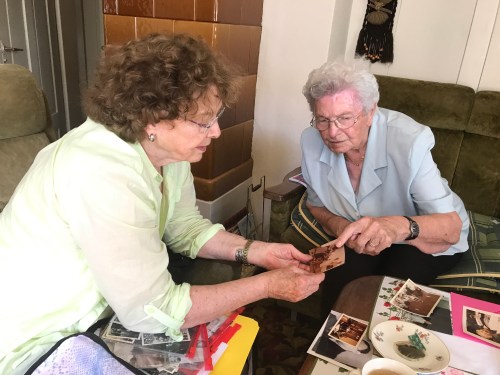


On Saturday we returned to Elsi’s house with Judi and spent the day filming her at her apartment for the documentary Judi is making “The Kindness of Strangers”.
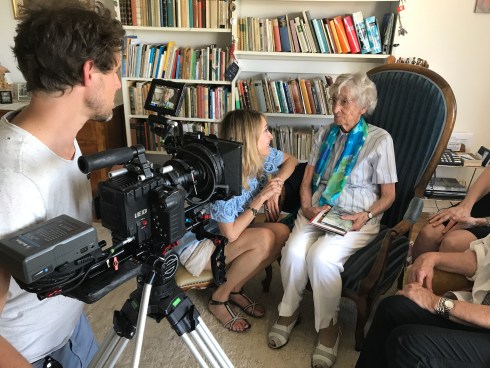
BASIL, Switzerland – Margot Wicki Schwartzchild & Joe Schwartzchild
Saturday evening on our way to my. grandmother’s hometown of Offenburg we stopped in Basil, Switzerland to meet Margot Wicki and her husband Joe. Margot, her sister Hannalore and their mother were interned at Rivesaltes camp in southern France at the same time as my mother at the start of WWII. My mom had been corresponding with Margot for over 10 years, but this was the first time they met in person. Many years ago, Elsi had read an article in a Zurich paper about Margot and Hannalore. Margot and Hannalore, whose mother was Catholic and father was Jewish, had a similar wartime experience in Germany and France, but they were a few years older than my mother. Unfortunately they were not as lucky as my mother and lost their father in Auschwitz. Elsi thought the three of them might connect. My mother wrote to them and they built a friendship over the years. Margot speaks at Swiss and German schools about her experience and she and her sister wrote a book about their family’s experience. Hannalore who also used to speak at the schools, unfortunately passed away a few years ago, so Margot now speaks on her own. We all had a lot to to talk about and Margot and Joe immediately felt like old family friends.
STRASBOURG, FRANCE
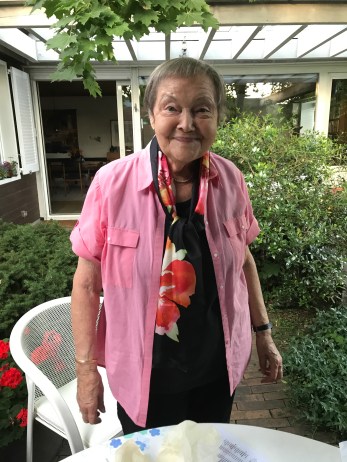
On Sunday we took the train across the Rhine to Strasbourg, France, the birth place of my grandfather Paul, to meet my grandmother’s cousins Lucie and Claude Hammel. Coincidentally, my friends Britt, Steve and Matt happened to be in Strasbourg the same day and we were able to meet them for lunch – they were own their own roots trip of sorts.


At Lucie & Claude’s we spent hours pouring through old family photos and exchanging stories.
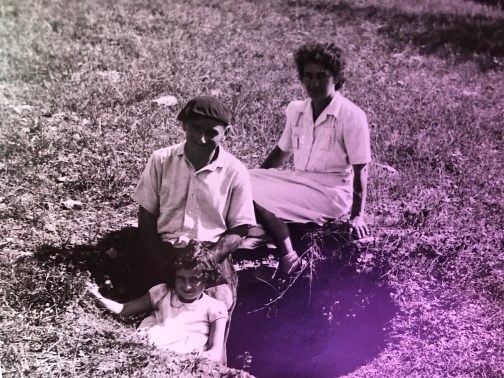
Claude was born in Bühl, Germany and Lucie was born in Strasbourg, France. The family moved to Strasbourg in 1933 and lived there at the start of the war and remained hidden in France throughout the war. Strasbourg in its entirety was evacuated in September 1939 because of bomb threats and the family had to leave the city in cattle cars on the train. All Strasbourg residents were assigned a family outside the city with whom they would stay and the Hammels ended up with the Labourd family on a farm in Brantome, where they remained for the next 4 years. For 1.5 years their father was away in the foreign legion and when he returned he wanted to get his own farm. In 1944, the Germans came looking for their family and they had to hideout in a hole on a hill outside the farm along with another jewish family. Everyday, the owners of the farm would bring them bread and something to drink. Claude who was 17 at the time did not want to stay in the hole with them and created his own hiding place. Soon after and until the war ended, Claude went to work for the French Resistance in Germany in the battle to free France. At the end of our visit (in which we spoke a combination of French, German and English), Lucie told us that this was the first they had spoken of their war times. They had never spoken more than a few words about those days, even with each other. Neither Lucie nor Claude had children who might have pushed them to keep their stories alive, and they didn’t think anyone else would be interested.


 rootstravel.blog